Container cranes
Heavy loads safely under control

Robust coupling technology for container cranes – high performance, reliable switching and maximum service life
Why container cranes need specialised coupling solutions
Container cranes handle heavy loads, operate for long periods and must do so with remarkable precision. A spreader must be securely picked up, positioned and set down again. Lifting, travelling and slewing movements must interact in a controlled manner. At the same time, vibrations, varying loads, wind and weather conditions all affect the entire system.
For drive technology, this means that container cranes require couplings and shaft connections that can reliably withstand high torques and abrupt load changes.
They must compensate for minor misalignments, control vibrations and continue to function even when access for maintenance is limited and the next operation cannot simply be postponed until tomorrow.
After all, time is a crucial factor in container handling. Any unplanned interruption not only slows down the crane but, in some cases, the entire logistics process.
When tonnes need to be positioned with millimetre precision
Mönninghoff couplings can be used in various areas of container cranes and crane systems, for example
- in hoisting mechanisms for raising and lowering containers
- in travel mechanisms for crane bridges and gantries
- in slewing and positioning axes
- in drives for spreaders and load-handling attachments
- in long shaft trains between the motor, gearbox and working machine
- in auxiliary drives and safety-critical holding functions
The movements are large, and the margin for uncontrolled movements is small. A crane must not only move loads, but also guide them safely and consistently. This requires drive technology that combines high performance with precise response.
Requirements for couplings and shaft connections
Container cranes place particular demands on mechanical power transmission. Key factors include
- High torque capacity Lifting and travelling movements generate large forces and often high torque peaks.
- Reliable handling of load changes Starting, braking, load pick-up and load release place dynamic stresses on the drivetrain.
- Robustness against vibrations Moving loads and long structures can introduce vibrations into the system.
- Compensation for misalignment Long shafts and moving assemblies cannot always be aligned perfectly.
- Low rotational play Precise motion transmission is essential when positioning the spreader and for the accurate setting down of containers.
- Long service life Cranes often operate for many hours a day and over long periods.
- Low-maintenance design Maintenance windows are valuable, particularly in ports and cargo handling terminals.
- Protection against environmental influences Moisture, salt, dust, temperature fluctuations and corrosion must be taken into account in the design.
- Compact and compatible geometry The coupling must be compatible with the existing shaft, gearbox and crane structure.
- Secure retention and controlled stopping Loads and moving assemblies must be reliably secured during standstill or in the event of an emergency stop.
A coupling for a container crane therefore has to be able to withstand a great deal. However, it should not only be robust, but also manage the load as effectively as possible within the system.
Connect, balance, protect
Mönninghoff develops coupling solutions for crane systems that are tailored to torque, speed, load profile and environmental conditions.
Electromagnetic toothed clutches
Electromagnetic toothed clutches enable positive-engagement shifting and are suitable for applications in which drives need to be engaged or disengaged in a defined manner. The positive-engagement connection allows high torques to be transmitted and clear engagement states to be achieved.
Possible applications include
- the engagement and disengagement of gearbox or drive stages
- shifting tasks in lifting and travel drives
- defined connections in auxiliary drives
- shifting operations where minimal rotational play is required
- synchronised motion sequences in the positioning of the spreader
With heavy loads, a clear ‘engaged’ or ‘disengaged’ status is more than just a convenience feature. It is an important component of controlled movement.
Electromagnetic multi-disc clutches
Electromagnetic multi-disc clutches combine high power densities with a compact design. They are particularly suitable for applications involving frequent engagement and disengagement, varying loads and potential speed differences between the input and output shafts.
In container cranes, for example, they may be of particular interest where
- drives are frequently switched on and off
- varying load conditions occur
- a rapid response is required
- installation space is limited
- thermal stresses and robust operation must be considered together
The multi-disc design can help to ensure reliable power transmission even during dynamic movements.
Torsionally stiff couplings
Long shaft runs are not uncommon in crane systems. They connect motors and gearboxes to distant drive points and, despite their length, must enable the most precise and stable power transmission possible.
Torsionally stiff couplings can compensate for minor misalignments and keep torsional play to a minimum. This supports, for example:
- the precise positioning of the spreader
- uniform power transmission in hoisting and travelling drives
- the relief of stress on bearings, shafts and gearbox connections
- the reduction of vibrations and unnecessary mechanical stresses
A good shaft coupling transforms several mechanical sections back into a reliable drive train.
Holding and braking systems
Even when a crane system is at a standstill, the drive technology remains under demand. Loads must be held securely, axles secured against unintended movement, and stops carried out in a controlled manner.
Depending on the task, electromagnetic holding brakes or other custom-designed braking systems may be used. Key considerations include
- reliable holding functions when stationary
- controlled deceleration of moving loads
- defined positions during maintenance and load transfer
- behaviour in the event of a power failure or emergency stop
- Integration into the crane system’s safety and control concept
In the case of a container crane, ‘holding’ should not only become an issue once the load is already in motion. It must be incorporated into the design from the outset.

To the product overview >
Request a quote for crane couplings >
Crane performance that makes a difference
Whether it’s a hoist, travel drive, spreader or long shaft connection: Mönninghoff develops couplings, brakes and drive components for container cranes that reliably move heavy loads and position them with precision.
Are you planning a new crane system, modernising a drivetrain or looking for a robust coupling for demanding port conditions? Talk to our experts about torque, load cycles, shaft geometry, environmental factors and holding functions. Together, we’ll get your crane system up and running safely and reliably.
Why manufacturers and operators rely on Mönninghoff coupling technology
Robustheit beginnt bei der richtigen Abstimmung
Jeder Containerkran hat seine eigene Geometrie und sein eigenes Betriebsprofil. Traglast, Hubhöhe, Fahrgeschwindigkeit, Schwenkbereich, Wellenlängen und Einsatzumgebung beeinflussen die Auswahl der passenden Kupplung.
Für die Auslegung können unter anderem folgende Parameter berücksichtigt werden
- Nenn- und Spitzendrehmoment
- Drehzahl und Beschleunigung
- Traglast und Lastverteilung
- Lastwechsel beim Aufnehmen und Absetzen
- Schaltzyklen und tägliche Betriebsdauer
- Wellen- und Getriebegeometrie
- Fluchtungsfehler und mögliche Wellenbewegungen
- Vibrationen und Schwingungen
- Temperatur, Feuchtigkeit, Salz und weitere Umwelteinflüsse
- gewünschte Halte-, Brems- und Not-Stopp-Funktionen
- Zugänglichkeit für Wartung und Inspektion
Mönninghoff entwickelt daraus keine allgemeine Kranlösung, sondern eine Kupplung, die zum konkreten Antriebsstrang passt. Dazu können Baugröße, Geometrie, Werkstoffwahl, Oberflächen und Schutzkonzept auf die jeweilige Anwendung abgestimmt werden.
When the environment is harsh, the technology must remain reliable
Container terminals and port facilities place high demands on corrosion protection and environmental protection. Moisture, salty air, dust and temperature fluctuations have a long-term effect on the components. Added to this are vibrations and dynamic loads from crane operations.
It is therefore important to consider the following right from the design stage
- which protection class and sealing method is appropriate for the installation situation
- which materials and surface finishes are suitable for the environment
- how the coupling is protected against corrosion and contamination
- how the component can be integrated into existing maintenance procedures
- what testing and documentation requirements apply to the crane systemRobust engineering does not simply mean using more material. The key lies in finding the right combination of function, material, geometry and protection.
From the initial crane concept to load testing
It can become apparent as early as the concept phase whether a coupling is suitable for the intended crane architecture. Mönninghoff provides support in the development of prototypes and functional models so that switching behaviour, load-bearing capacity and integration can be tested at an early stage.
Possible test criteria include
- Torque transmission under rated and peak loads
- Behaviour during abrupt load changes
- Switching times and switching reliability
- Compensation for misalignment
- Vibrations and noise levels
- Wear and thermal stress
- Holding and braking functions
- Behaviour during emergency stops and power failures
- Integration into the crane control system and existing interfaces
Tests under realistic conditions lay the foundation for a solution that is not only mathematically sound but also proves its worth in day-to-day crane operation.
Container cranes
[nbsp]
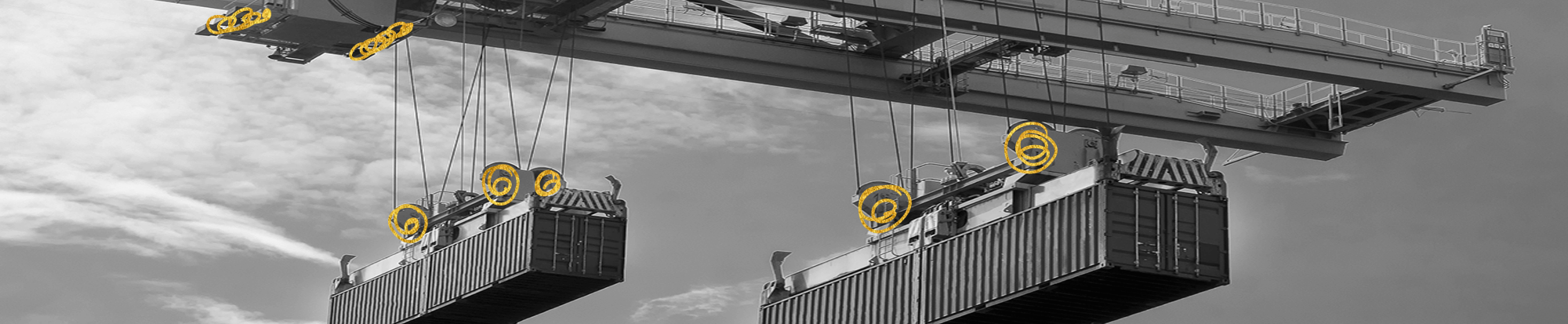
In such heavy-duty applications Mönninghoff drive technology can really prove itself to a full extent. The heavy load in the system can easily be handled with our exceptionally high power density and we also offer load-holding and fail-safe solutions. Even extreme weather conditions can not affect the reliable function of our products.
As with any Mönninghoff system we offer the integration of further components or sensors to design the perfect fit for any application.